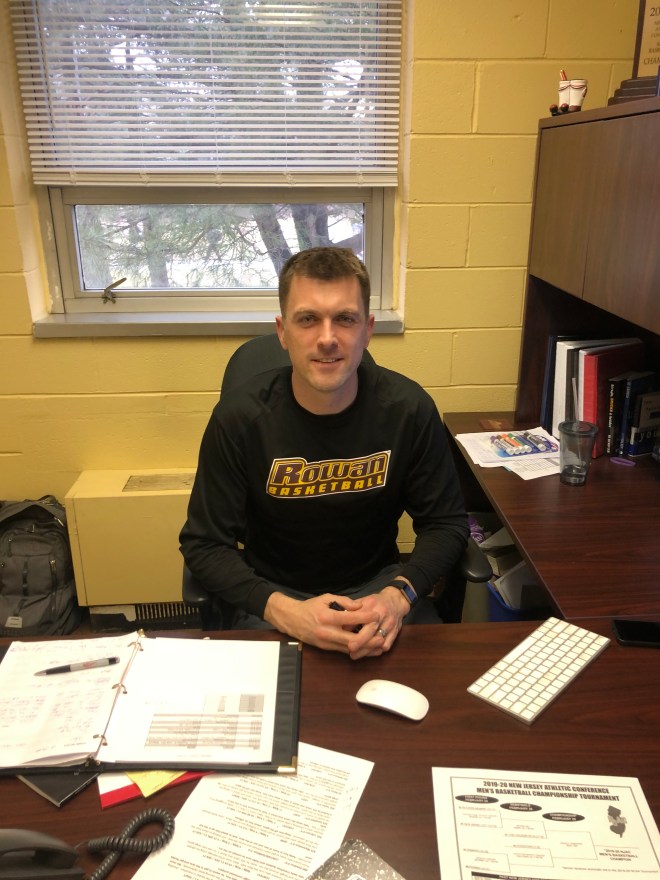
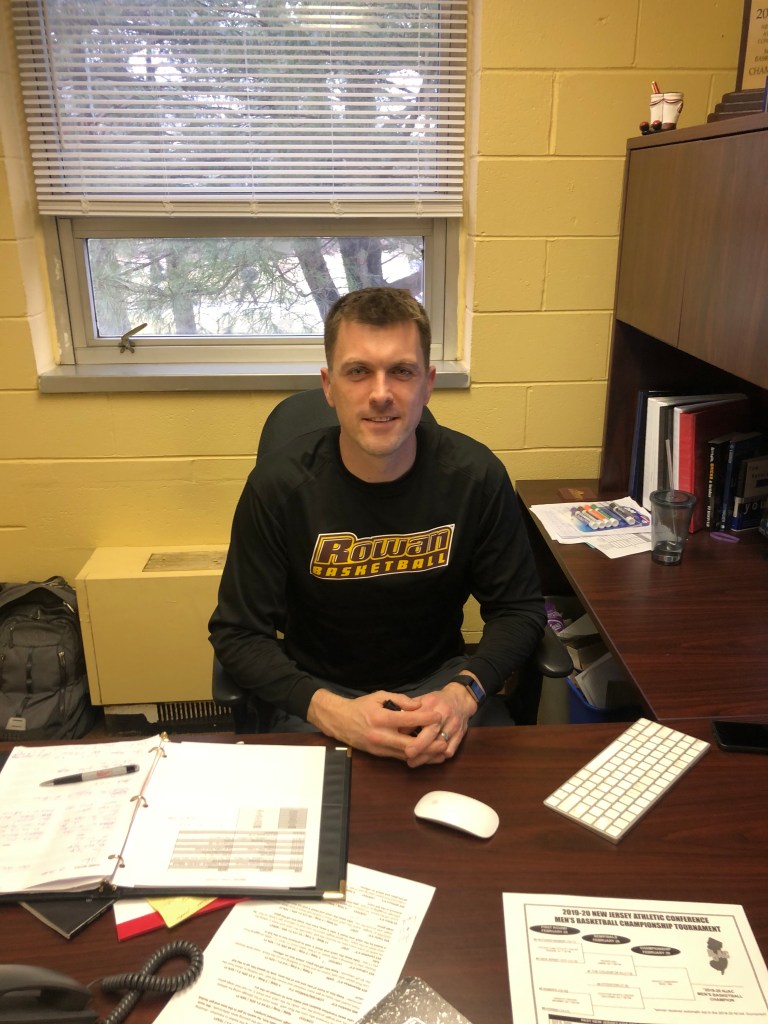
Joe Crispin has dedicated his life to the game of basketball and everything it has to offer. As a player at Pitman High School, Crispin averaged 35.6 points per game as a junior and senior, and went on to win the New Jersey Group 1 state championship. He attended Penn State University where his success continued leading to a NCAA Tournament win over Kentucky that will always be remembered in Pennsylvania in 2001. After finishing college, he enjoyed a 12 year professional career, and has now transitioned into coaching. He took over the Profs in May of 2016 after being an assistant coach for 2 years, and helped lead the team to it’s first NJAC championship since 1999 in the 2018-2019 season. He now resides in Glassboro, New Jersey with his wife Erin, and his 5 children. I sat down with Joe to discuss his coaching and playing career, and gain some insight on his coaching style and approach to coaching college athletes.
How did you get into basketball, and can you describe your journey ?
- I grew up with basketball in the blood. My grandfather played basketball at Temple,(he’s from Woodstown). My father grew up in Glassboro and played at Glassboro High School and then went to Villanova for football, and eventually came back to coach for Glassboro. So when I was a kid I just lived in the gym, my dad was a head coach, my grandfather was a junior college coach, my uncle was a high school coach. So I was immersed in the basketball world, that was just kind of my normal. And then as I progressed, I always loved the game, and always loved playing sports in general, but basketball was always number one in the house. Then naturally I was able to have success in high school, college, and then played professionally. When I returned me and my wife moved back into this area and fortunately, an opportunity opened up here at Rowan, and I was excited because this is home for me and I’m happy to be here.
How did it feel to be part of the 2001 Penn State Team that upset North Carolina in the NCAA Tournament?
- I had a great experience at Penn State. Penn State recruited me late. I waited most of my senior year, and played it out and was really fortunate and thankful to end up there. We had some good years, but my senior year oddly enough wasn’t consistently the best season, but it ended the best. Similar to our year this year you suffer a little bit during the year and you end up better. It was an incredible experience, and at the time I didn’t enjoy it or appreciate it as much as I should’ve. Since I’m such a big competitor so even to this day I’m like we should’ve won the next one. Usually when March rolls around I’ll say to my wife “ Wow we actually did that, my brother and I on the court together, we had a great senior group, great group of guys kind of an underdog group.” Penn State folks remember it fondly because it was really the one and only Sweet Sixteen appearance.
When you were playing in college, how did you balance being a full time student as well as playing for a D1 basketball program?
- If I’m being completely honest, I wasn’t very balanced at all. My wife was, she had played soccer and was an honor student, my grades were fine but I definitely wasn’t very balanced. I was smart enough to know what I needed to do in the classroom but to be honest I was a very very very very driven athlete. I did what I needed to do in the classroom, and typically I was over 3.0 but was I doing my best? No probably not, I wanted to be an NBA player, and I tell my guys all the time I was fortunate enough to get by and do what I had to do. Naturally it’s a different level from Division 3 to Division 1, because at a D1 program were working at it all year and we used to have a 20 hour thing; it was essentially a full time job. At Penn State they really value academics, and they put the pressure on you to do well and that helped me. I didn’t graduate on time because I had 3 or 4 more classes I had to take. I should’ve stayed up in the summer, but I didn’t because I loved playing summer basketball here in Philly and working out with people. I think the big thing is, even though I was out of balance, because of some things in place like study hall and accountability I succeeded. I think one of the other main reasons I did fine academically was that I wasn’t outrageously social, I wasn’t partying, I wasn’t going out, that just wasn’t me. I did what I had to do. My perspective was “ shoot, I gotta keep up with my school work and I want to be a professional basketball player, so I’m investing dozens of hours a week into basketball, I don’t have time for that other stuff, it’s not gonna help me.”
How do you hold your players accountable, and do you have any ways that you get through to them when it comes to their grades?
- Yea we’re growing in that, Coach Albright who’s one of my assistant coaches really leads the way in that. He meets with the guys academically, and has started a study hall. That’s something we’re growing in because we didn’t have anything in place when I took over. The difference here at our level, and with me at Penn State was that Penn State had way more resources, and it wasn’t like the coaches were putting pressure on me, the academic counselors were putting pressure on me. I was also a full scholarship. The thing I tell people about becoming a pro; the only difference from D1 to the pros is that I got a check, and I didn’t have to go to school. The pressure was the same, the stage was the same, sometimes smaller. At this level it’s different, I tell my guys all the time; you’re paying for school, I wasn’t paying for school and I knew that. I think that’s the difference at this level, there’s a built in sense of accountability. If you don’t do well you’re just gonna have to pay for it again. Part of it is that we want to hold you accountable, and push you, but at the same time I’m a big believer in owning it. My regret for myself as a student was not embracing the learning process as much and just getting things done. I love that now and I didn’t love that then because I was so focused on basketball, and that’s something I preach to my players. It’s not just about you getting a grade, it’s about you learning how to learn, and learning how to manage life. It’s not just about what you learn in the classroom, it’s about communicating with teachers, learning how to manage life and owning it. We don’t necessarily have the resources here to be all over them and do things for them. So we push them to say listen: you have to make this happen.
What’s your favorite part about being a head coach?
- Probably one of the biggest things to me is seeing guys grow and mature in tangible ways. When you see guys step up in a playoff game with confidence and with risk taking and ownership in a way that they wouldn’t have in November; that’s not something that shows up on the stat sheet, it’s not something you can write an article about, but that’s where the magic happens. And I feel like that is helping kids grow on a personal level, and I don’t know how you measure that, but it’s a powerful thing. So that’s something I focus on probably more than most coaches because I believe in that. I think it does carry over to the rest of life, in life when you’re able to step up to those challenges, it leads to a lot of positive things in life. And to add another thing; seeing a group come together, we have a lot of diversity, guys from different backgrounds, and it’s messy. But when it comes together it’s super super rewarding because it’s not a natural fit.
What are some personal goals you have for this team going forward?
- Well for the program, it’s to be a national champion and continue to take the steps necessary to achieve that. But for this team, I would love to see them just play free and play aggressive like they have been. My goal for them in the beginning of the year was to be the best team they could be, and be the most dangerous team come playoff time. It doesn’t mean we’ll win every game, but I think we have reached that goal this year which is rewarding. There was a lot of suffering involved towards getting to that goal, and I think of Belichick when people ask him about his goals, he’ll say my goal is to have a good practice today.
How do you get your players motivated and ready for the games?
- I just let them own a lot of stuff. I’m a big believer in owning things. Philosophically, I just believe in letting players play. That doesn’t mean I don’t coach them, what we do is simple but it’s not easy. It involves players trusting and communicating with each other and that’s a process. It’s not always an easy process but it’s a good process and it works for this group of guys.
Can you tell me a story about a special moment that you won’t forget?
- For me it’s the NJAC finals last year against Jersey City. It’s not for the reasons people think it’s not just because Matt Green made a huge jump shot, it’s because there was a level of trust, and a level of player ownership that wasn’t there the year before. It took a lot of work to get to that point, but it wasn’t just working on your left hand dribble. It was working on your relationships, working on your trust level, and owning your own game. And when we played that game I don’t think I made a single call all game. The guys owned it and at the end of the game Matt Green wanted it, and his teammates trusted him to take the shot. He knew he had the power and confidence to take the shot and we wanted him to. You can’t put your finger on it, but that’s where the magic happens and that’s where the fun is. When there’s that level of trust and empowerment. That’s what we’re about. When I feel at my best is when the players are confident and know I have that strong confidence in them. I didn’t call timeouts, I didn’t call plays, I just empowered them to play their game and they did. A lot of coaches struggle with that, and that’s just something I believe in and I’m not afraid to fail. I want my team to be fearless and confident, and that’s how we play and that’s when we’re at our best. In coaching it’s tough to get credit for what you choose not to do. Usually you get less blame and more credit when you choose to intercede and do something in a game. When you call a timeout or call a play and it doesn’t work, you get less blame. If you sit and do nothing you don’t get as much credit and more blame. I think that’s stupid, and you often end up with something better by not doing anything but it’s hard. I’ve driven that into my own skull, and as a coach I’ve always had this belief that it’s better to just let the guys play and I don’t always do it right and it’s as a whole it’s just something I believe in and stick to.
 rubalanced.health.blog
One thought on “Building a Champion- Q&A with Rowan Men’s Basketball Head Coach Joe Crispin”